
ossified tendons
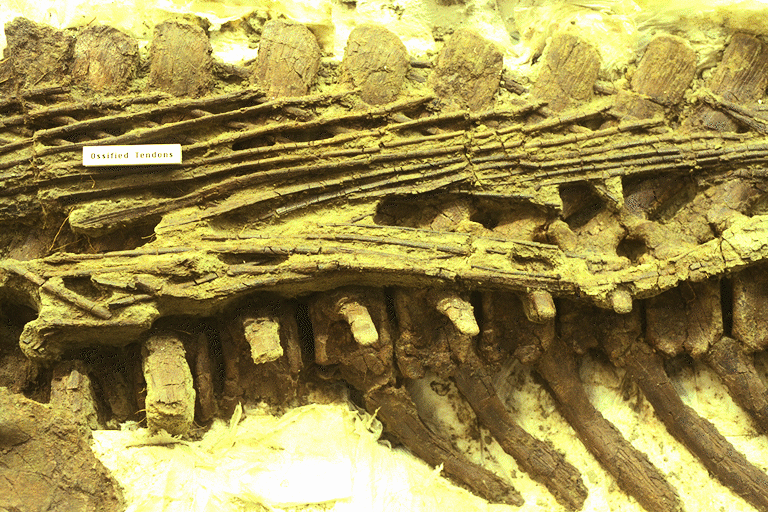
Ossified tendons, a distinctive feature of Edmontosaurus fossils from the Hell Creek Formation (Maastrichtian, Late Cretaceous, ca. 66 million years ago), are mineralised connective tissues that stiffened the dinosaur’s tail and back, aiding in locomotion and stability. Edmontosaurus, a large hadrosaurid dinosaur, roamed the subtropical floodplains of what is now Montana, Wyoming, and the Dakotas, and its ossified tendons are frequently found preserved in the formation’s sandstones and mudstones. These tendons, forming a lattice-like structure along the vertebral column, were composed of collagen in life but became mineralized during fossilization, preserving as hard, bony rods. Their presence, particularly around the tail, suggests Edmontosaurus relied on a rigid, flexible tail for balance while moving bipedally or foraging as a facultative biped in lush, riverine environments alongside other dinosaurs like Tyrannosaurus.
The ossified tendons of Edmontosaurus provide critical insights into its anatomy and lifestyle, revealing a robust musculoskeletal system adapted for supporting its massive, 30–40-foot-long body. In the Hell Creek Formation, these fossils are often found in association with vertebrae and limb bones, embedded in fine-grained sediments that indicate deposition in low-energy floodplain or river channel settings. The tendons’ diamond-shaped arrangement enhanced structural integrity, allowing Edmontosaurus to maintain posture during grazing or rapid movement to evade predators. Their exceptional preservation, due to rapid burial in the formation’s wet, sediment-rich environments, offers paleontologists clues about hadrosaur biomechanics and the dynamic ecosystems of the Late Cretaceous, where Edmontosaurus thrived as a dominant herbivore.