
MEGALOSAURUS BUCKLANDII
TOOTH SHARD
This piece of enamel came from a Megalosaurus bucklandii tooth found at a quarry in Gloucestershire along with several other Megalosaurus fossils (one of which is pictured below). It came from the Great Oolite Group (Chipping Norton Formation) and dates to between 170 - 160 million years old.
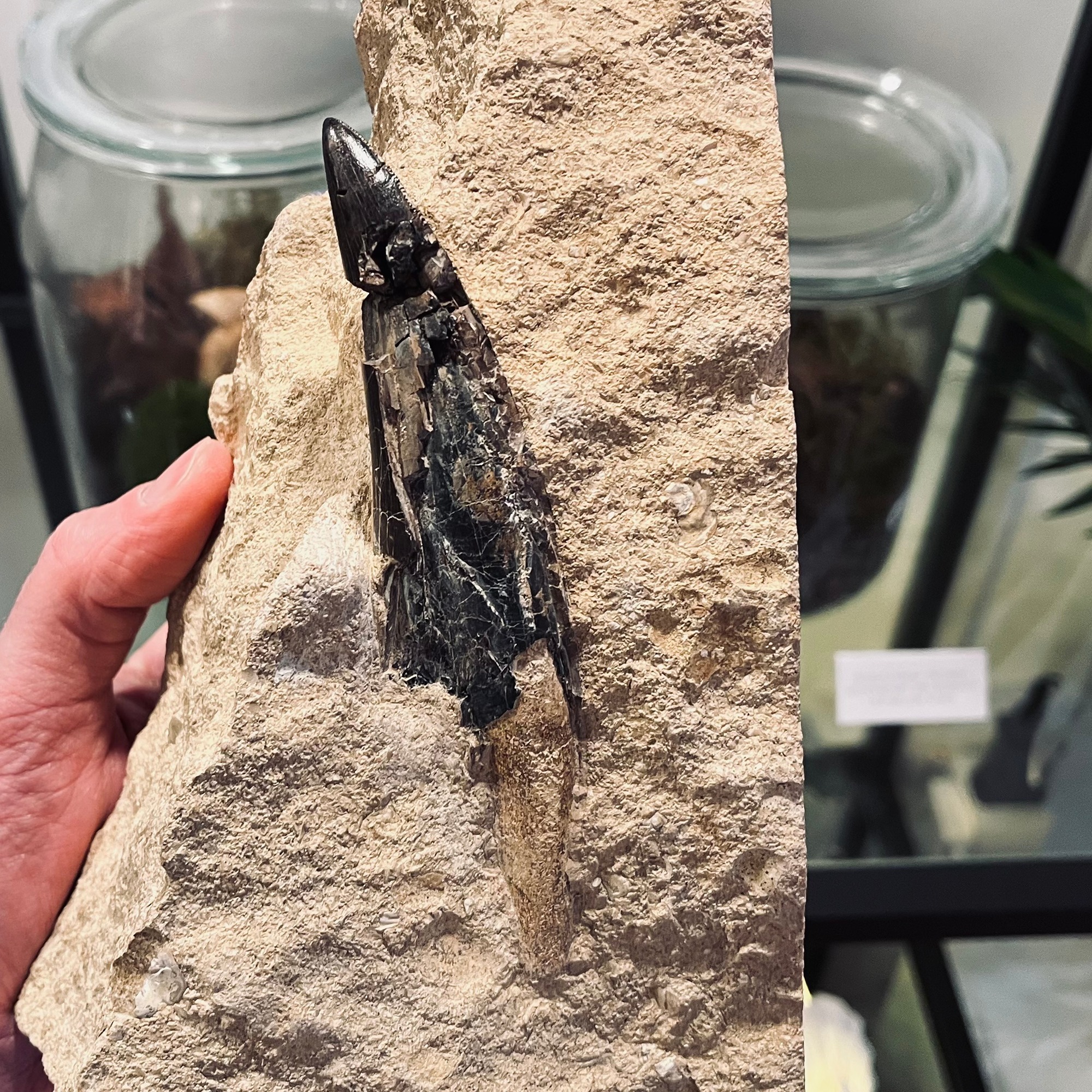
Megalosaurus bucklandii, one of the first dinosaurs scientifically described, was named in 1824 by William Buckland, a British geologist and theologian, based on fossils found in Oxfordshire, England. The name "Megalosaurus" derives from Greek words meaning "great lizard," reflecting its status as a large carnivorous theropod from the Middle Jurassic period, approximately 167 million years ago. Buckland's description, aided by anatomist William Brookes, included jaw fragments, vertebrae, and limb bones from the Stonesfield Slate formation, marking it as the inaugural dinosaur in scientific literature—predating the term "dinosaur" coined by Richard Owen in 1842. Initial reconstructions erroneously depicted it as a quadrupedal reptile, but later studies corrected this to a bipedal predator.
This theropod measured 6–9 meters (20–30 feet) long and weighed around 1–2 tons, featuring powerful hind legs for bipedal locomotion, sharp serrated teeth for tearing flesh, and strong forelimbs with three-fingered hands equipped with claws. As a member of the Megalosauridae family, it likely preyed on large herbivores and smaller dinosaurs in a forested, riverine environment, using its robust skull and conical teeth to crush bone and consume carcasses. Fossils, primarily from the UK with possible relatives in France and Tanzania, reveal a robust build adapted for ambush hunting. Though overshadowed by more complete specimens like Tyrannosaurus, M. bucklandii holds historical significance for kickstarting paleontology and highlighting early Jurassic megafauna diversity.