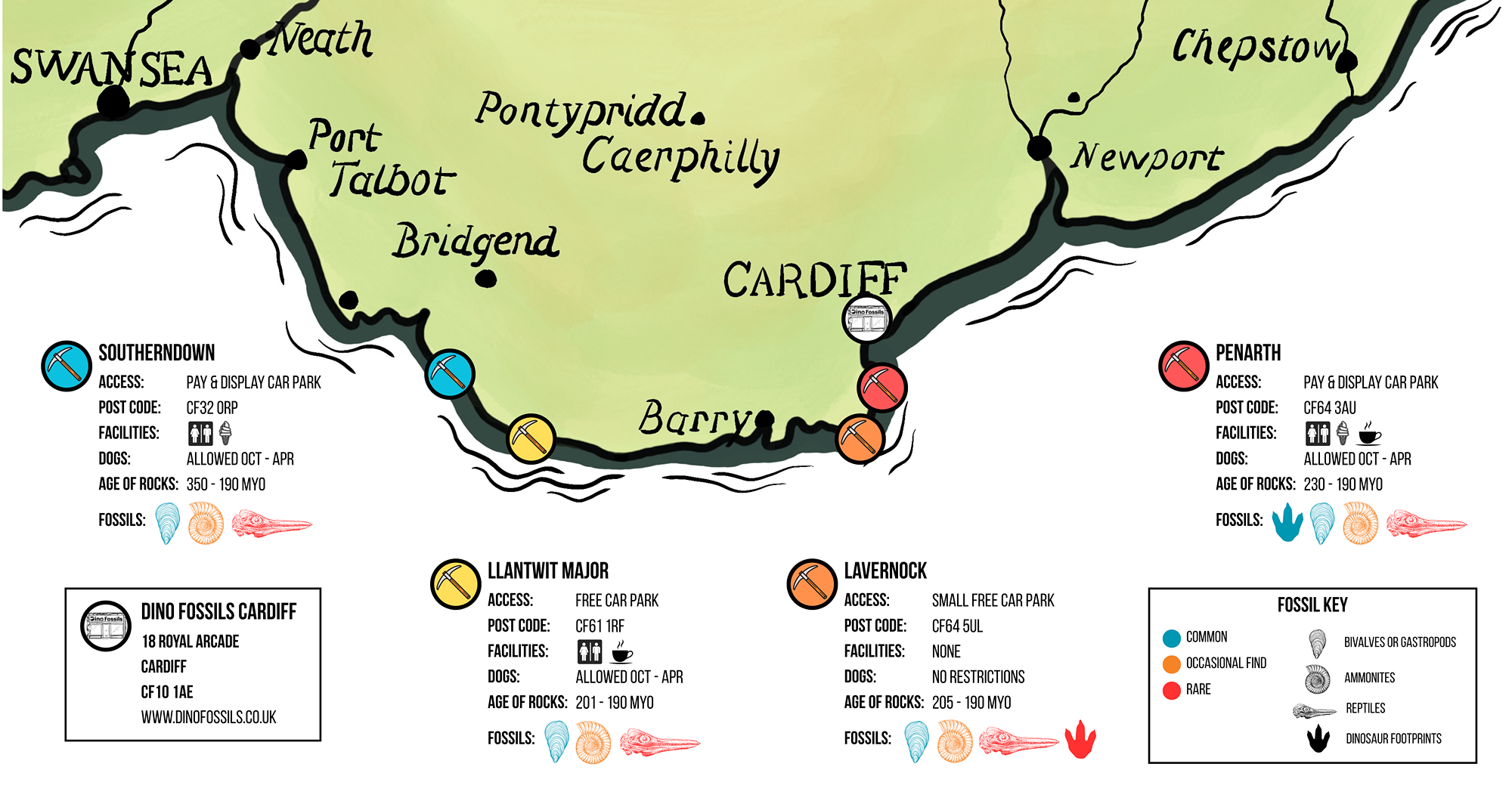
The welsh jurassic coast
The South Wales coast showcases a remarkable geological transition from the Late Triassic to the Early Jurassic, reflecting dramatic environmental shifts. During the Late Triassic (approximately 225–201 million years ago), this region was an arid desert on the northern margin of an ancient sea, characterized by the Mercia Mudstone Group. These striking red and green dolomitic mudstones, rich with white and pink gypsum bands, were deposited in evaporating lakes under a hot, dry climate, as seen in the cliffs at Penarth Head. Dinosaur trackways, such as those near Penarth, indicate large tetrapods roamed this desert landscape, leaving rare footprints in the mudrocks. The Penarth Group, including the Westbury Formation’s “bone bed,” marks the transition to marine conditions, containing fish bones and tiny teeth, evidence of the encroaching sea.
By the Early Jurassic (approximately 201–190 million years ago), the region transformed into a warm, shallow tropical sea, depositing the Blue Lias formation, visible at Southerndown and Penarth, with alternating limestone and shale layers. This environment teemed with marine life, preserving abundant fossils like bivalves (Gryphaea and Plagiostoma), ammonites (Psiloceras and Schlotheimia), and occasional ichthyosaur remains, found among beach pebbles and cliffs. The shift from desert to sea reflects a global transgression, flooding the terrestrial landscape. At Southerndown, the Blue Lias limestones yield bivalves and rare reptile remains, while Penarth’s fossil-rich pebbles highlight the biodiversity of this ancient tropical seascape.
South wales fossil hunting map
(click to expand)